Guide
Are Ottoman Beds Good? Pros, Cons and the Numbers to Check
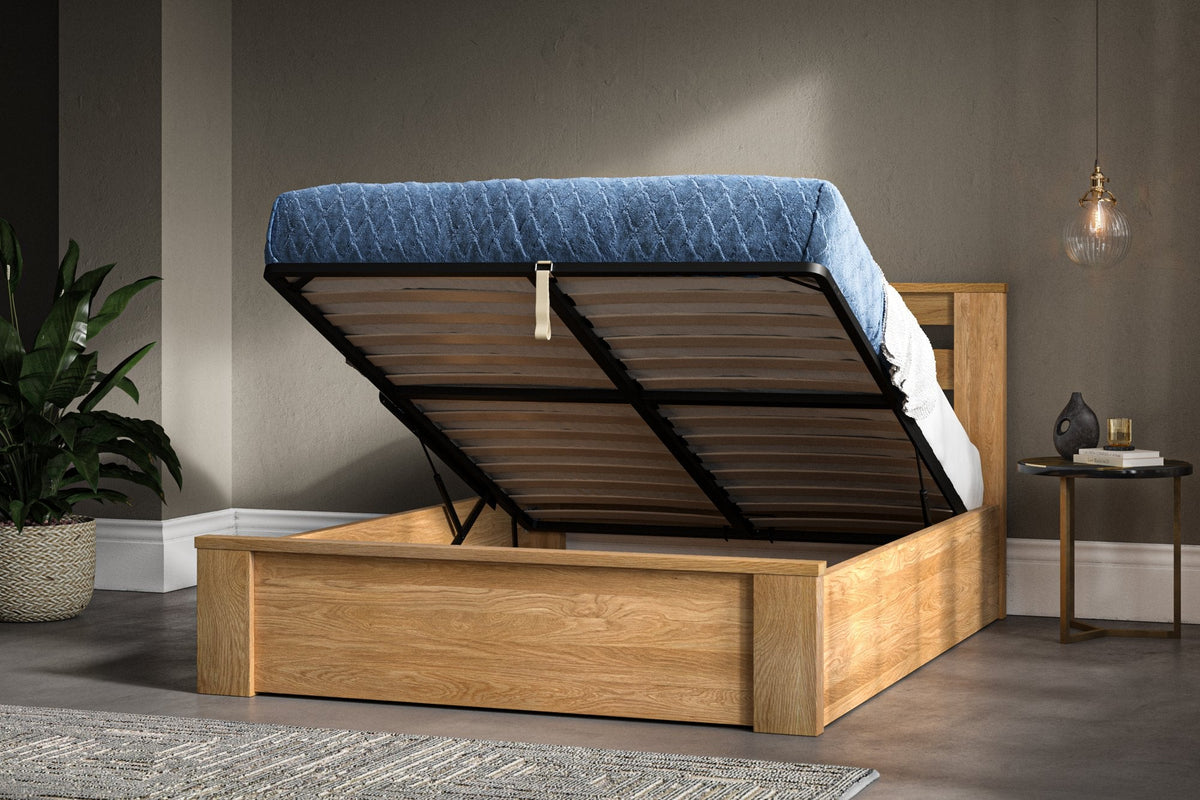
Yes, if you are short of storage. The whole base lifts on gas struts with the mattress on it, and the space underneath becomes one box the size of the bed. It suits a small bedroom well, and suits you less if you move house often or sleep on a very heavy mattress. The bed figures on this page are the makers' own, for the 43 ottoman beds we sell, checked on 17 October 2026.
What is an ottoman bed?
An ottoman bed is a bed frame whose base, the platform the mattress lies on, is hinged at one end and held up by a pair of gas struts. You lift the free end, the base rises with the mattress still on it, and underneath is a storage well that covers the footprint of the bed. Closed, it looks like any other bed with a headboard.
It is one of two ways to build storage into a bed. The other is drawers, in a divan base or in a frame. An ottoman gives you one big space that you reach from above. Drawers give you several smaller ones that you reach from the side, every day if you like.
The name is borrowed from the ottoman, the padded footstool named after the Ottoman Empire. A storage ottoman has a lid that lifts, and so does the bed.
How does an ottoman bed work?
Two gas struts, one on each side, do most of the lifting. They are sized for the base plus a mattress within a weight band, which is why the base should always be lifted with the mattress on it. Lifted bare, a base can spring up hard and look faulty when it is not. Our guide to ottoman bed gas struts explains the newton figure printed on each one.
Of the 43 ottoman beds we sell, 39 say they lift on gas struts or a gas lift, three of them calling it a hydraulic lift; the cloud bed, the Harlesden, the Morden and the Bexley do not say. None of them publishes a strut rating. Where a maker does, that rating is about lifting the base. It is not the weight the bed takes when you lie on it.
One base also has a lock: the maker of the Eltham lists a safety lock with its gas strut.
End lift or side lift?
An end lift base is hinged at the headboard and rises from the foot. A side lift base is hinged along one long side and rises from the other. Which one you need depends on the room, not on the bed.
Our guide to side lift ottoman beds goes through the rooms a side lift suits, which way the base rises, and the two we sell.
| Opening | Where you stand to open it | Choose it when | On this site |
|---|---|---|---|
| End lift | At the foot of the bed | The foot end has clear floor in front of it | 24 of our 43 ottoman beds say so |
| Side lift | Along one side | The foot end is against a wall, a radiator or a wardrobe | 2, the Pimlico and the Mayfair |
Swipe sideways to see the whole table
For the other 17, the maker's details we have do not say which end lifts. If your room depends on it, ask us before you order and we will check with the maker. The note on the Chiswick is a good rule for any end lift: the base lifts at the foot end and stays hinged at the head, so leave space to stand at the foot of the bed when you open it.
What the makers actually publish
Storage is the reason to buy an ottoman, so the depth of the well is the number to look for. Many makers leave it out. This is what the makers publish for the 43 ottoman beds on this site.
| What we looked for | What the makers publish |
|---|---|
| Depth of the storage | Given for 13 beds: from 22 to 31 cm, most often 25 or 27 cm |
| Which end lifts | 24 at the foot, 2 at the side, 17 not stated |
| Gas strut rating | Not given for any of them |
| Weight limit for the bed | Given for 12 beds: from 200 to 400 kg |
| Weight of the frame | Given for 18 beds: from 35.9 to 90.8 kg |
| Width of a king size frame, outside | From 157.5 to 174 cm |
| Price on this site | Single £209 to £319, small double £229 to £439, double £259 to £729, king £259 to £1,549, super king £379 to £669 |
Swipe sideways to see the whole table
A depth of 27 cm over a king size base of 150 x 200 cm encloses about 810 litres, before the struts and the cross rails take their share. In practice, measure the deepest thing you want to keep there. A cabin case 25 cm deep lies flat in 27 cm; a suitcase 30 cm deep does not go in at all.
The deepest figure among our beds is the Edgware's: 31 cm, according to its maker. When a listing anywhere promises lots of storage without a figure in centimetres, ask for one.

The pros
Storage under the whole bed
22 of our ottoman listings say in so many words that the storage runs under the whole base. Few things in a bedroom give you that much space without taking up floor.
No floor space needed beside the bed
Drawers need clear floor beside the bed to open, usually around 45 cm, and you lose them on any side that is against a wall. An end lift ottoman opens upwards from the foot, so the bed can sit tight between two bedside tables.
The struts do most of the lifting
The struts carry most of the load, so you are not lifting the full weight of the mattress when you open it. That holds as long as the struts suit the mattress, which is why the weight band matters.
Every size, at no extra cost here
Ottomans come in every UK size from single to super king. On this site the median king size ottoman costs £399, against £469 for a king size frame without storage. Across UK shops it is the other way round: our king size bed price survey puts the median king ottoman at £540, against £499 for all king frames.
The cons
Heavy, and moving house means taking one apart
The makers who give a weight put their frames at 35.9 to 90.8 kg. Assembled, a king size ottoman is far wider than a doorway: a standard UK internal door is 762 mm wide, and our king size ottomans measure 157.5 to 174 cm across the outside. Our guide on how to dismantle an ottoman bed gives the order and the safety rules.
The struts wear, and they depend on the mattress
A strut that loses gas lets the base sink. A mattress outside the weight band makes the base drop or fly up. Where a maker gives a maximum mattress thickness, respect it: the Grosvenor's is 20 cm, and deep pocket sprung super king mattresses often go past that.
You lift the bed to reach anything
That suits suitcases, spare duvets and winter clothes. It does not suit the things you use every day.
The numbers that matter are often missing
30 of the 43 beds have no storage depth from their maker, and 31 come with no weight limit for the bed. BS EN 1725:2023, the current standard for beds, bases its tests on people weighing up to 110 kg, and none of our 43 ottoman listings names it. If either of you is heavier than that, read our guide to heavy duty bed frames before choosing.
Ottoman bed or divan with drawers?
| Ottoman bed | Divan with drawers | |
|---|---|---|
| Storage | One well the size of the bed | Drawers, shallower than the base |
| Space it needs to open | Room to stand at the foot, or at one side | Clear floor beside the bed, usually around 45 cm |
| Reaching things every day | Awkward, you lift the bed | Easy |
| Getting it upstairs | Flat packed, carried in pieces | Rigid base sections that do not come apart |
Swipe sideways to see the whole table
For the most storage, choose the ottoman. For things you reach every day, choose drawers. Our guide to what a divan bed is covers the rest.
Are ottoman beds comfortable?
As comfortable as the mattress you put on them. The base changes the feel a little: sprung slats flex under the mattress, a rigid deck feels firmer. Three of our ottoman beds say they have sprung slats: the Barnet, the Ruislip and the Acton. Once the bed is closed, the lift plays no part in how it sleeps.
Are ottoman beds safe?
Yes, used as intended. The risk is the lid. When a strut loses gas, the base sinks or drops, and fingers are what get caught. Three habits avoid it: lift and close the base with the mattress on, replace both struts as soon as the base starts to sink, and keep children out of the storage well and away from a raised base. If your base has a safety lock, like the Eltham's, use it every time.
BS EN 1725:2023 includes test methods for finger entrapment. Since none of our ottoman listings names the standard, it is a fair question to ask before you buy.
Can you put a normal mattress on an ottoman bed?
Yes. An ottoman takes the standard UK mattress for its size: 90 x 190 cm for a single, 120 x 190 cm for a small double, 135 x 190 cm for a double, 150 x 200 cm for a king and 180 x 200 cm for a super king. Check two things. The thickness, where the maker gives a limit or a range: 20 cm at most on the Grosvenor, 15 to 25 cm on the Muswell. And the weight, because the struts are sized for a band of mattress weights. A European 160 x 200 cm mattress does not fit a UK king. All the sizes are in our UK bed sizes chart.
Who should buy one
Buy one if your bedroom is small, you have no loft or spare cupboard, and what you want to store is bulky and seasonal: suitcases, spare bedding, winter coats.
Think twice if you move house every year or two, if you need to reach the stored things daily, or if you sleep on a deep, heavy hybrid mattress.
If one of you weighs more than 110 kg, choose a frame whose maker states a weight limit. Among our ottomans, seven give 400 kg in king size: the Lewisham, Holloway, Acton, Ruislip, Wembley, Tooting and Barnet. None of them splits that figure per sleeper.
Which ones we would choose
For a king on a budget, the Camden: velvet, end lift, £289 in king size. If the foot of your bed is against a wall, one of our side lifts, such as the Pimlico from £229, or the Mayfair from £729. For the deepest published storage in stock, the Wembley or the Lewisham, fully boarded and about 30 cm deep, from £389 and £399. For solid oak, the Chiswick, 100% solid oak according to its maker, with 25 cm of storage, £1,049 in king size. For a king with a stated weight limit, the Acton: 400 kg according to its maker, sprung slats and 27 cm of storage, £399. For a super king with a published maximum load, the Grosvenor: 300 kg, £389.
The full ranges are in king size ottoman beds, super king ottoman beds, double ottoman beds, small double ottoman beds, single ottoman beds and, in wood, wooden ottoman beds.
Prices and figures checked on 17 October 2026.